What if Delhi wasn’t just the city you landed in before heading to Agra, Jaipur or the mountains—but the destination you actually stayed back to explore?
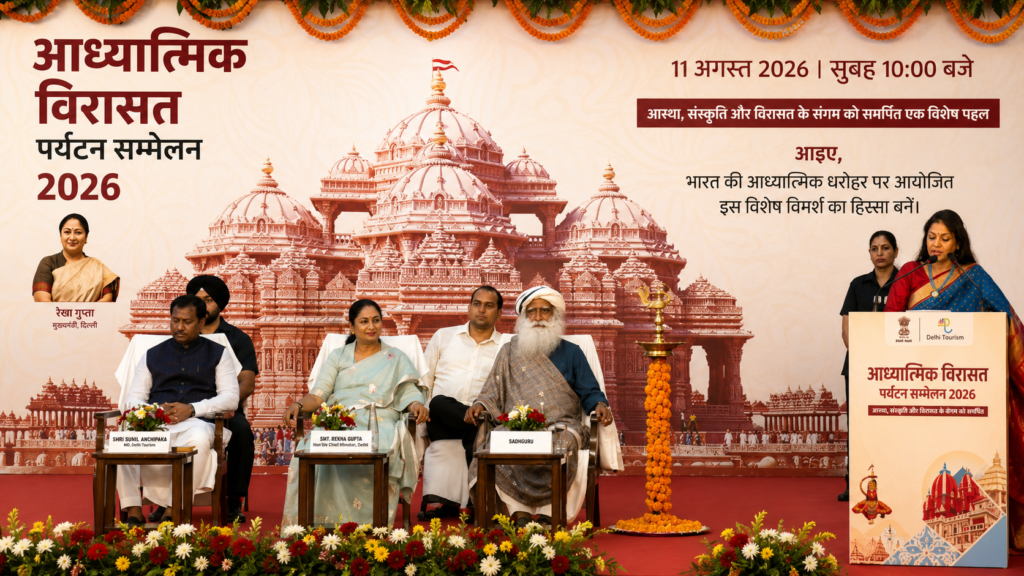
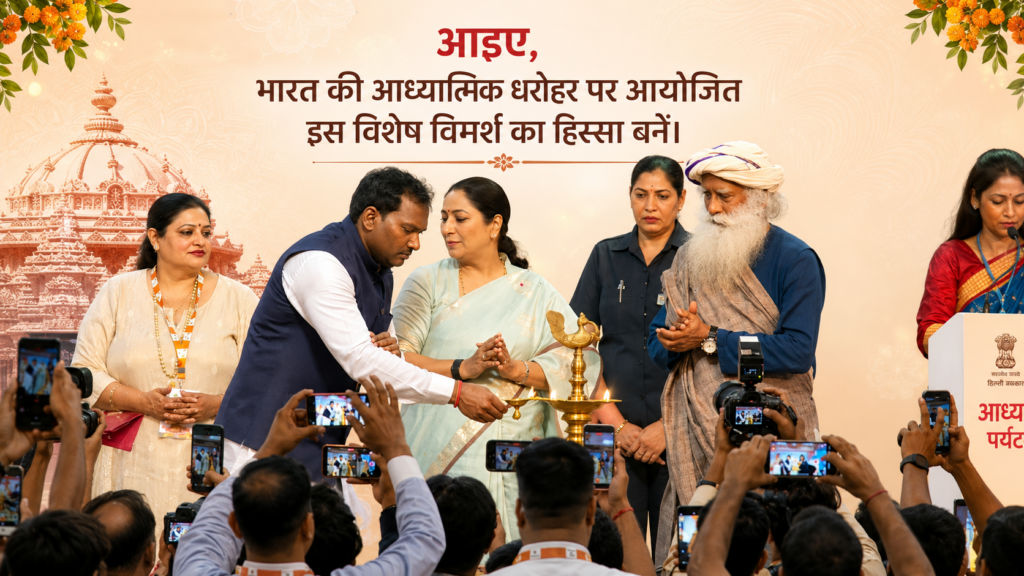
That’s the idea behind a major new tourism push announced by Delhi Chief Minister Smt. Rekha Gupta, who launched four new Spiritual and Heritage Tourism Circuits at the Spiritual and Heritage Tourism Conclave 2026 held at Swaminarayan Akshardham Temple on August 11.
With spiritual guru Sadhguru Jaggi Vasudev also present at the conclave, the event focused on an ambitious vision: transforming Delhi from a ‘transit city’ into a ‘destination city’.
And honestly, Delhi has been waiting for this moment.
Delhi Is More Than Red Fort and India Gate
When someone says “Delhi tourism”, the usual checklist is pretty predictable—Red Fort, India Gate, Qutub Minar, Humayun’s Tomb and perhaps a plate of butter chicken somewhere in between.
But Delhi’s story is far bigger.
It is a city where a morning can begin with prayers at a gurdwara, continue with the architecture of a historic monument, move into the serenity of a temple or church and end with the spiritual energy of Nizamuddin.
That diversity is precisely what the new tourism initiative wants travellers to experience.
Speaking at the conclave, Chief Minister Rekha Gupta emphasised that Delhi is not merely a city to be seen, but a city to be experienced. The larger vision is to encourage visitors from India and across the world to stay longer, explore its neighbourhoods, experience its food and traditions, and connect with its spiritual and cultural heritage.
Four New Circuits, One Very Delhi Story
The four tourism circuits created by Delhi Tourism bring together religious, spiritual, historical and cultural landmarks located across the capital.
Instead of experiencing individual monuments in isolation, travellers can now explore curated journeys connecting multiple facets of Delhi.
1. The Soul of Delhi
This circuit brings together some of the capital’s most recognisable spiritual and architectural landmarks:
- Agrasen ki Baoli
- Lotus Temple
- Swaminarayan Akshardham Temple
- Gurudwara Bangla Sahib
- Sacred Heart Cathedral
From an ancient stepwell to contemporary spiritual architecture and places of worship representing different faiths, this circuit captures the city’s incredible diversity in one journey.
2. The Heritage of Delhi
For those who love history, architecture and stories hidden in plain sight, The Heritage of Delhi circuit connects:
- Birla Temple
- Jhandewalan Mata Mandir
- Jantar Mantar
- Yogmaya Temple
- Jagannath Temple
This is the Delhi where centuries-old traditions meet the rhythm of a constantly evolving capital.
3. Delhi Sacred Harmony
Perhaps one of the most interesting journeys for travellers looking to understand Delhi’s spiritual diversity, this circuit includes:
- Ancient Hanuman Temple
- Digambar Jain Lal Mandir
- Dr. Ambedkar Memorial
- Purana Qila
- Hazrat Nizamuddin Dargah
Here, history, faith and architecture come together to tell a story about Delhi’s pluralistic identity.
4. Echoes of Delhi
The fourth circuit takes travellers across another fascinating mix of heritage and spirituality:
- Buddhist Temple
- Church of Redemption
- Mehrauli Archaeological Park
- Chhatarpur Temple
- Gurudwara Rakab Ganj Sahib
- Linga Bhairavi Sannidhanam
It is essentially a journey through the many voices, faiths and traditions that have shaped the capital.
The Big Idea? Don’t Just Take a Picture. Stay.
Perhaps the most important part of the initiative is that it isn’t simply about creating another sightseeing list.
The government’s larger objective is to encourage visitors to spend more time in Delhi.
Instead of arriving in the morning, ticking off two or three monuments and leaving the city the same evening, the vision is to encourage tourists to stay overnight and explore different parts of the capital.
And that could have a ripple effect.
More tourists staying longer means more business for hotels, restaurants, tour operators, local guides, artists, artisans and small entrepreneurs.
In other words, tourism isn’t just about monuments. It’s about creating an ecosystem around the experience.
Delhi’s Greatest Attraction? Its Diversity
One of the strongest messages emerging from the conclave was that Delhi’s identity cannot be defined by a handful of monuments.
Yes, the city has the Red Fort, Purana Qila and Humayun’s Tomb.
But it also has magnificent temples, gurdwaras, churches, mosques, Buddhist and Jain places of worship, archaeological sites, historic neighbourhoods and spiritual spaces.
And then there is the Delhi that has been created by its people.
People from almost every part of India call the capital home, bringing their food, festivals, languages and traditions with them.
From Garba during Navratri to Ganesh Chaturthi celebrations, Bihu, South Indian cultural traditions and North Indian festivals, Delhi often feels like a mini India—especially during the festive season.
That cultural melting pot is something few cities can replicate.
Why Spiritual Tourism Could Be Delhi’s Next Big Story
The world is increasingly looking towards India for experiences centred around spirituality, yoga, mindfulness, peace and inner wellbeing.
Delhi, with its extraordinary mix of ancient traditions and modern urban life, has the potential to become an important destination for this audience.
The newly launched circuits attempt to package that diversity into experiences that travellers can actually discover, rather than leaving them to piece together an itinerary themselves.
And that’s what makes the initiative interesting.
It isn’t asking tourists to simply “see Delhi.”
It is inviting them to experience Delhi—its prayers, architecture, stories, food, people, traditions and history.
From Transit City to Destination City?
Delhi has always been a city people pass through.
Now, the government wants to make it a city people stay for.
The launch of these four tourism circuits is a step towards that larger ambition—putting Delhi’s spiritual and heritage identity on the global tourism map while creating new opportunities for the city’s tourism and hospitality ecosystem.
Because perhaps the best way to discover Delhi isn’t to rush through its famous landmarks.
It is to slow down.
Take that extra day.
Walk through an old neighbourhood. Listen to a qawwali. Step into a centuries-old place of worship. Explore a forgotten archaeological site. Eat something delicious. Talk to a local.
And discover that Delhi has always been much more than a capital.
It has always been an experience.